
Great product very quick service package is good will definitely buy again in future
15% Off All Teas + Free Shipping Australia-Wide Over $70 | Use Code T3
Video Review: REAL REVIEWS, REAL RESULTS!
Watch 30-second video reviews from our happy customers.
March 01, 2026 7 min read
If you spend enough time in the tea industry, you begin to notice two very different types of tea businesses.
The first type is built around excitement. A person falls in love with wellness products, designs a logo, opens a Shopify store, orders some packaging from overseas, and expects sales to start rolling in.
The second type understands that tea is a real business. Margins matter. Packaging matters. Customer retention matters. Flavor matters. Logistics matter. Compliance matters. Most importantly, consistency matters.
The second group survives.
Over the past several years at , we have worked with wellness brands, naturopaths, influencers, cafés, online retailers, beauty businesses, gyms, and first-time entrepreneurs looking to create their own tea ranges. Some have gone on to build successful brands. Others disappeared before their second order.
This article is designed to give you a realistic understanding of what it actually takes to start a tea business in Australia today.
Not the Instagram version. The real version.
Tea sits in an interesting category because it overlaps several growing markets at once:
• wellness
• beauty
• functional beverages
• low-alcohol lifestyles
• self-care
• gifting
• hospitality
• premium food products
Australians are also becoming more ingredient-conscious. People increasingly read labels. They want to know where ingredients come from, whether products are organic, whether packaging is sustainable, and whether a brand feels authentic.
At the same time, consumers are moving away from highly processed drinks and looking for alternatives that feel calmer and more natural.
That has created opportunities for smaller tea brands that understand branding, storytelling, and niche positioning.
But this also means the market has become crowded. Generic tea products no longer stand out.
If you want to build a successful tea business in Australia in 2026, you need more than a pretty pouch.
The most common mistake we see is people trying to create a tea business for “everyone.”
That never works.
The strongest tea brands are highly targeted.
Examples include:
• hormone-support teas for women
• high-end Japanese matcha brands
• sleep and relaxation teas
• premium chai blends
• iced tea brands
• tea brands for cafés
• sports recovery herbal teas
• tea for pregnancy and motherhood
• luxury gifting teas
• tea for beauty salons and wellness clinics
The clearer your niche, the easier your branding and marketing become.
Customers need to instantly understand what makes your business different.
This decision changes almost everything in your business.
Loose leaf tea generally gives you:
• lower production costs
• larger visual ingredients
• more flexibility
• easier small-batch production
• premium positioning
However, some customers find loose leaf tea inconvenient.
You also need customers to own infusers or teapots.
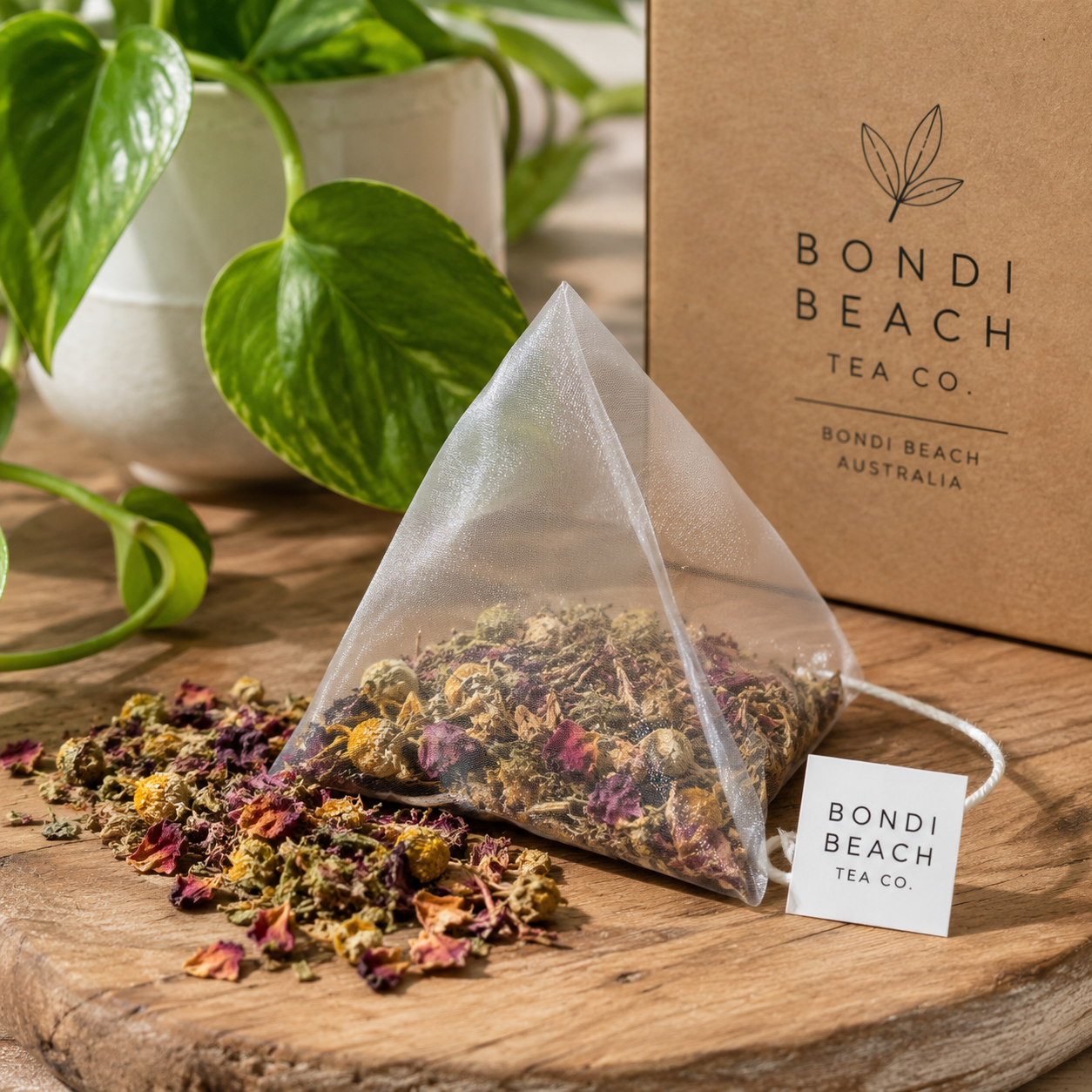
Pyramid tea bags are extremely popular because they offer convenience while still allowing larger tea leaves and ingredients to expand properly during brewing.
Cheap supermarket tea bags often use dust-grade tea particles. Pyramid tea bags allow room for proper ingredients.
At Bondi Beach Tea Co., we use plant-based Soilon pyramid tea bags, which are made from PLA derived from renewable resources such as cornstarch.
This creates a more premium brewing experience compared to conventional paper tea bags.
Pyramid tea bags also photograph extremely well online, which matters more than many people realize.
The downside is that pyramid tea bags significantly increase production complexity and cost.
Not every ingredient works well inside a tea bag.
Large fruit pieces, sticky ingredients, powders, or dense roots can create sealing problems or poor infusion performance.
A blend that works beautifully as loose leaf may completely fail as a tea bag.
That is something most first-time tea businesses do not understand until production begins.
Organic tea continues to grow strongly in Australia.
Consumers increasingly associate organic products with:
• cleaner ingredients
• higher quality
• wellness positioning
• premium branding
However, “organic” also creates responsibility.
If you are sourcing from a manufacturer using certified organic ingredients, you need to understand what claims you can legally make within Australia.
Many new tea brands assume they can immediately place certified organic logos on packaging. That is often not the case unless proper certification transfers are in place.
This is why it is important to work with an experienced tea manufacturer that understands both sourcing and compliance.
These are two very different paths.
White label tea means selecting existing blends and placing them under your own branding.
Advantages include:
• lower development costs
• faster launch times
• reduced risk
• easier minimum order quantities
• proven flavors
This is often the smartest way to start.
Many successful tea companies begin with white label products before investing heavily into custom formulations.
Custom blending means developing entirely unique recipes.
This process is far more involved than most people expect.
A proper tea blend must balance:
• flavor
• aroma
• visual appearance
• ingredient compatibility
• brewing performance
• ingredient cost
• shelf stability
• manufacturing practicality
Some ingredients taste wonderful individually but become unpleasant in combination.
Others overpower an entire blend at tiny inclusion levels.
Valerian root is a good example. Functionally, many people love the idea of it in sleep teas. But in reality, valerian can dominate a blend with an earthy, almost fermented aroma that many customers dislike.
The art of blending is often about restraint.
Packaging is not just about appearance.
It affects:
• shelf life
• freshness
• shipping costs
• customer perception
• margins
• sustainability positioning
In Australia, matte stand-up pouches remain extremely popular because they feel premium and protect ingredients well.
However, there are major differences between cheap packaging and high-quality packaging.
Low-grade pouches may:
• allow oxygen transfer
• lose seals
• fade in color
• wrinkle easily
• feel thin and cheap
Customers notice these things immediately.
Good packaging quietly builds trust.
MOQs are one of the most misunderstood parts of starting a tea business.
People often want tiny quantities across many different products.
Unfortunately, manufacturing does not work efficiently that way.
Every blend requires:
• setup time
• sourcing
• blending
• testing
• labeling
• packing
• warehousing
• administration
This is why manufacturers have minimums.
In tea, packaging often creates even larger minimums than the tea itself.
Custom printed pouches from overseas suppliers can require runs of 1,000 units or more per design.
Many businesses underestimate how quickly packaging costs add up.
People frequently ask us:
“How much money do I need to start?”
The honest answer is that it depends entirely on how professionally you want to launch.
A very basic startup using white label products and labels can begin relatively affordably.
A premium custom tea brand with custom formulations, professional packaging, photography, website development, influencer marketing, and inventory can quickly become expensive.
Areas people often underestimate include:
• photography
• branding
• packaging revisions
• freight
• warehousing
• advertising
• Shopify apps
• influencers
• customer acquisition costs
The tea itself is often not the biggest expense.
Marketing usually is.
Shopify remains one of the best platforms for new tea businesses.
It is relatively easy to use and integrates well with:
• subscriptions
• email marketing
• dropshipping systems
• fulfillment centers
• SEO tools
However, many tea businesses make the mistake of launching a beautiful website with almost no educational content.
That is a huge error.
Tea businesses should invest heavily in:
• educational blog articles
• ingredient pages
• brewing guides
• sourcing stories
• comparison articles
• FAQ content
Google increasingly rewards websites that demonstrate genuine expertise.
Thin AI-generated blog content is becoming less effective.
The brands that will survive are the ones creating genuinely useful content written by people who understand the category deeply.
SEO in the tea industry has changed dramatically.
Years ago, you could publish dozens of weak articles stuffed with keywords and still rank.
That no longer works consistently.
Google increasingly looks for signals of expertise, authority, and trust.
This especially applies to wellness-related industries.
The strongest tea content today tends to be:
• detailed
• experience-based
• specific
• useful
• naturally written
The irony is that many brands now use AI to produce hundreds of low-quality articles, which makes genuinely helpful content stand out even more.
If you can produce excellent long-form educational content consistently, you can still build strong organic traffic.
This depends on your skill set.
Retail requires:
• branding
• customer acquisition
• social media
• paid advertising
• influencer relationships
Wholesale requires:
• relationship building
• consistency
• logistics
• competitive pricing
• reliability
Many tea businesses fail because they underestimate how difficult direct-to-consumer marketing has become.
Getting website traffic is expensive.
Sometimes supplying cafés, clinics, salons, or wellness stores can create more stable revenue early on.
Consumers increasingly care about sustainability.
They ask questions about:
• packaging
• tea bags
• sourcing
• plastics
• compostability
This is one reason Soilon pyramid tea bags have become popular in premium tea manufacturing.
Customers want products that align with their values.
But sustainability claims must also be accurate.
Consumers are becoming more educated and skeptical.
Despite all the technology, tea remains an incredibly relationship-driven industry.
Reliable suppliers matter.
Reliable freight partners matter.
Reliable manufacturers matter.
A delayed shipment of packaging can disrupt an entire launch.
An unreliable ingredient supplier can destroy consistency.
Many successful tea brands are built quietly over years through strong operational relationships rather than flashy marketing.
Starting a tea business in Australia can absolutely work.
But the businesses that succeed usually approach tea as a long-term brand rather than a quick trend.
The strongest brands tend to focus on:
• consistency
• trust
• education
• quality
• clear positioning
• customer experience
Tea is not simply a product.
It is ritual, routine, wellness, hospitality, and storytelling combined together.
That is why great tea brands often build surprisingly loyal customers.
People rarely become emotionally attached to ordinary products.
But they absolutely become attached to the tea they drink every day.
Comments will be approved before showing up.
May 16, 2026 5 min read
Read MoreJune 16, 2025 3 min read
Read MoreSign up to get the latest on sales, new releases and more …
Great product very quick service package is good will definitely buy again in future
A great tasting tea that does what it says